In-Depth Analysis of Grid-Connected Inverter Testing with the IT7900E Grid Simulator
Introduction: In renewable energy grid-connected systems, the grid-tied inverter serves as the critical interface between distributed energy sources and the public power grid. Its behavior not only affects power generation efficiency, but also directly impacts the safety and stability of the grid. As a result, international standards impose extremely stringent requirements on inverter grid adaptability, protection response speed, and power quality.
However, the real power grid cannot intentionally create faults, nor can it accurately reproduce the disturbance conditions specified in testing standards. Meanwhile, conventional AC power sources lack the dynamic regulation capability and standardized waveform support required for such tests. Only a high-precision, high-dynamic, programmable AC grid simulator can truly meet the demands of modern grid-connected inverter validation.
This article focuses on the ITECH IT7900E Series Regenerative Grid Simulator, providing an in-depth explanation of why an AC grid simulator is the only reliable choice for inverter grid-connection testing, and demonstrating its practical applications in key test scenarios such as LVRT (Low Voltage Ride Through), anti-islanding protection, and harmonic immunity testing.
Why an AC Source Is a Must — Three Major Limitations of Traditional Methods
❌ Limitation 1: Relying on the Real Grid → Unable to
Actively Trigger Faults
The real power grid is stable and cannot be manipulated to create voltage sags,
frequency deviations, or harmonic injections. This makes mandatory tests such
as LVRT, HVRT, and frequency ride-through impossible to perform.
❌ Limitation 2: Using Ordinary AC Power Supplies →
Insufficient Dynamic Response
Conventional inverter-type AC sources have low output bandwidth and cannot
complete voltage step changes within milliseconds, leading to distorted test
results and even misjudgment of inverter performance.
❌ Limitation 3: Lack of Standards Compliance → High
Certification Risk
Standards like IEC 61000-4-11/4-13/4-14/4-17/4-28 clearly require test
equipment to provide specific waveform generation capabilities with precise
timing.
✅ Conclusion: Only a professional AC grid simulator with built-in standard waveforms, high bandwidth, and bidirectional energy feedback capability can deliver repeatable, traceable, and standards-compliant grid-connected inverter testing.
The Core Value of an AC Source: More Than “Power Supply,” It’s a “Grid Behavior Replicator”
The ITECH IT7900E Series is not just an AC power supply—it is a programmable virtual grid system with irreplaceable capabilities. In such tests, the AC source acts as an “intelligent grid agent”—serving simultaneously as the inverter’s grid connection point, a fault injector, a data collector, and an energy recovery unit.
|
Capability
|
|
Testing Significance |
||
|
High-Speed Voltage/Frequency Transients |
Response time < 200 μs |
Accurately reproduces standard LVRT/HVRT waveforms |
||
|
Built-in International Standard Test Templates |
Preloaded sequences for IEC 61000-4-11/4-13/4-14/4-17/4-28, etc. |
One-click compliance testing, eliminating manual programming errors |
||
|
RLC Islanding Simulation |
Configurable RLC values or PQ settings to create islanding conditions |
Meets anti-islanding test requirements |
||
|
Harmonic / Interharmonic Injection |
Supports independent settings for up to 50 harmonics, with adjustable amplitude/phase |
Validates inverter stability under distorted grid conditions |
||
|
Energy Recovery |
Grid-connected inverter output energy can be absorbed and fed back by IT7900P |
Significantly reduces test energy consumption, supports long-duration full-load operation |
Typical Test Scenario Explained: How an AC Source Drives Grid-Connected Inverter Validation
Scenario 1: Low Voltage Ride-Through (LVRT) Test — Example: GB/T 37408-2019
Standard
Requirement:
When the grid voltage suddenly drops to 0.2 p.u. and lasts for 150 ms, the
inverter must not disconnect from the grid, and its active power must recover
to ≥90% within 2 seconds after voltage restoration.
IT7900E Operation
Logic:
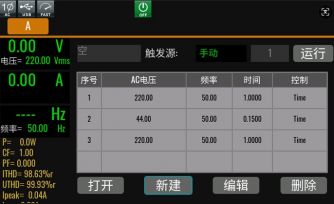
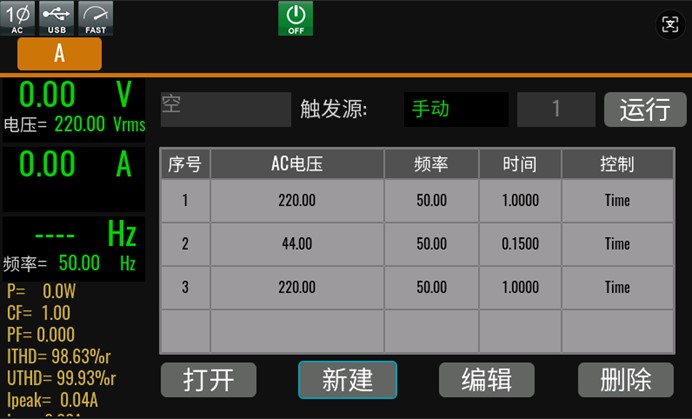
Set the LIST-rated condition: 230 V / 50 Hz. Configure a voltage dip of 20%,
duration 150 ms, and automatically record whether the inverter output current
is interrupted and whether the power recovery curve meets the standard.
Advantage
Highlight:
Conventional power supplies cannot complete a transition from 230 V to 46 V
within 1 ms, whereas the IT7900P can precisely control the voltage drop edge,
ensuring the test’s validity.
Scenario 2: Grid Harmonic Immunity Test — IEC 61000-4-13
Test Content:
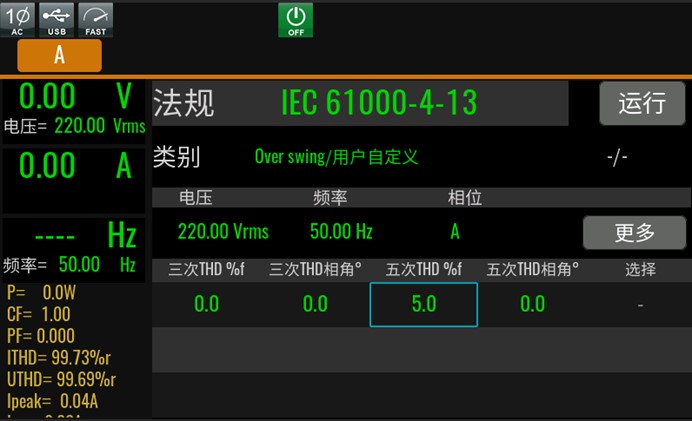
Inject 5% of the 5th harmonic (250 Hz) into the grid for 10 minutes, and verify
whether the inverter remains connected and its output THD ≤ 3%.
IT7900E
Implementation:
Use the built-in IEC standard functions to simulate harmonics, while
simultaneously monitoring the inverter’s output power quality through the integrated
analyzer.
Conclusion: An AC Source Is Not Optional—It Is Essential
As grid-connection standards continue to evolve, inverter testing is shifting from simply “whether it can connect to the grid” to “how intelligently it can interact with the grid.” This transformation relies entirely on the capability boundaries of high-precision AC grid simulation power sources.
The ITECH IT7900E Series was designed to address this trend. It is not merely a testing instrument, but a compliance bridge connecting product design with grid regulations.
For any inverter manufacturer aiming to enter the global market, investing in a professional AC source means investing in both product market access and brand credibility.