How to Solve Voltage Sag Caused by Motor Start-Up Inrush Current
Introduction: The Importance of Electric Motors in Industrial Systems Electric motors are everywhere in modern life. From household appliances to industrial equipment and transportation systems, they rely heavily on electric motors to provide power. The core function of a motor is energy conversion: it efficiently converts electrical energy into mechanical energy (as in motors) or vice versa (as in generators). This fundamental capability makes motors a critical component in nearly all power-driven systems.
The widespread adoption of electric motors is driven by several advantages, including high efficiency, environmental friendliness, easy controllability, and the ability to transmit energy over long distances. These characteristics make them superior to internal combustion engines in many applications.
For example, in the industrial sector, motor systems account for approximately 50% of global energy consumption, and up to 80% of industrial energy usage. In household applications, motors are essential for appliances such as washing machines, refrigerators, and air conditioners.
Technological advancements have further expanded motor applications. High-efficiency motors such as brushless DC motors (BLDC) and permanent magnet synchronous motors (PMSM) have significantly improved energy efficiency. In addition, the use of variable frequency drives (VFDs) has further enhanced performance and reduced energy consumption.
The integration of IoT and artificial intelligence has enabled predictive maintenance, reducing downtime and improving system reliability. These innovations not only lower energy consumption but also expand motor applications into areas such as electric vehicles and high-speed rail, making electric motors a foundational technology for modern engineering and sustainable development.
I. Voltage Sag Caused by Motor Start-Up Inrush Current
When a DC power supply is used to drive a motor, a large inrush current occurs at the moment of start-up. If the dynamic response (ΔU) of the power supply is insufficient, the output voltage will drop sharply. This voltage sag may cause the system to shut down, preventing normal load or burn-in testing.
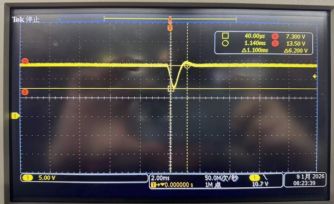
As shown in Figure 1, when the motor inrush current reaches 10 A, the power supply voltage temporarily drops to 7.3 V. Since the device’s undervoltage protection threshold is 7.5 V, this voltage dip triggers the protection mechanism, resulting in system shutdown.
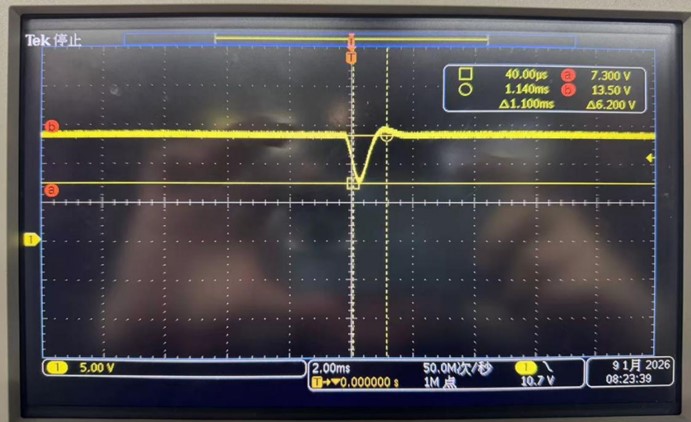
Figure 1
II. How to Solve Voltage Sag Caused by Motor Start-Up Inrush Current
Solution 1: Adding Parallel Capacitors to the Existing Power Supply to Reduce Voltage Drop
Capacitors cannot change voltage instantaneously. They store electrical charge (Q = C × V). When the load suddenly increases and the power supply output voltage (V) tends to drop, the capacitor immediately discharges, releasing stored energy to supplement the current demand, thereby reducing both the speed and magnitude of the voltage drop.
Provides a high-frequency current path. Capacitors (especially small-value ceramic capacitors) have very low impedance to high-frequency transient currents and can provide a “local return path” for the high-frequency components of the inrush current, preventing them from flowing through long power supply loops and causing additional voltage drop.
As shown in Figure 2, after adding a 1680 µF capacitor in parallel to the original power supply, the voltage drops to 9.6 V.
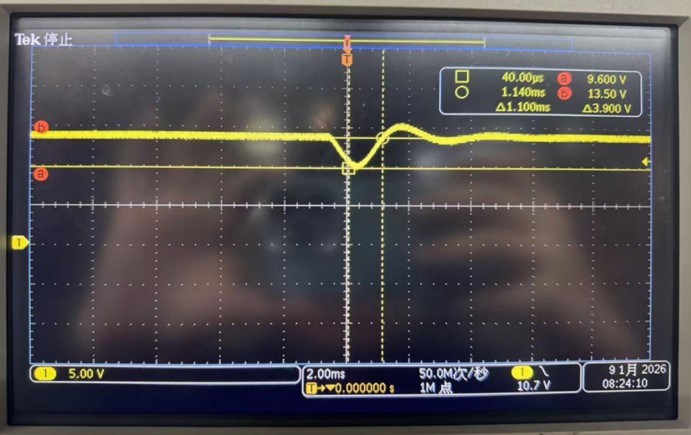
Figure 2
Capacitance estimation
The required total capacitance can be roughly estimated based on the inrush current and the allowable voltage drop.
Formula: C ≈ I × Δt / ΔV
C: required capacitance
(Farads, F)
I: peak inrush current (Amps, A)
Δt: duration of inrush current (seconds, s)
ΔV: maximum allowable voltage drop (Volts, V)
Example:
When the load starts, it requires 2 A current for 10 ms, and the allowable
voltage drop of the 12 V supply is not more than 0.5 V.
C ≈ 2 A × 0.01 s / 0.5 V = 0.04 F = 40,000 µF
This is a very large value and may require multiple large capacitors in parallel. In practice, the power supply itself also has some regulation capability, so the actual required capacitance may be lower than the calculated value. However, the calculation provides an order-of-magnitude reference.
Solution 2: Select a power supply with better dynamic performance (lower ΔU)
For example, the ITECH 3900C series power supply has better dynamic performance under higher current pulses (0–75 A with a 90 µs current rise slope). The dynamic voltage variation (ΔU) is better, and the voltage drop is only 680 mV (as shown in Figure 3).
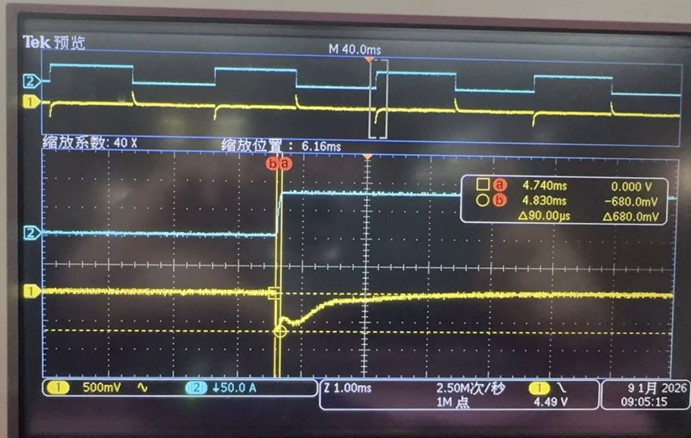
Figure 3
In addition, the IT-M3900C is a regenerative bidirectional programmable DC power supply. It integrates both bidirectional power supply and regenerative electronic load functions, and feeds consumed energy back to the grid in a clean way. The high-efficiency energy regeneration not only reduces power consumption and cooling costs, but also does not interfere with grid operation.
The IT-M3900C provides high-precision output measurement, high reliability, high safety, and rich measurement functions. These features enable the IT-M3900C series to meet the requirements of high-precision ATE testing, and it is also widely used in automotive electronics, new energy vehicles, photovoltaic energy storage, intelligent industrial equipment, battery simulation, and other applications.