Why Use a Programmable Grid Simulator?
Programmable Grid Simulators: A Key Tool for Modern Power Electronics Testing With the rapid growth of renewable energy and the increasing complexity of power electronic systems, comprehensive, efficient, and safe testing of photovoltaic inverters, energy storage converters, and EV charging equipment has become a critical challenge.
Traditional testing methods, which rely on the real grid or basic power sources, are limited in test scenarios and often suffer from high energy consumption, safety risks, and poor repeatability.
The emergence of programmable grid simulators addresses these challenges, making them an indispensable tool in modern power electronics testing.
1. Limitations of Traditional Testing Methods
-
Dependence on
the real grid
Limited by grid stability and safety constraints, making it difficult to simulate extreme conditions such as voltage dips, frequency variations, and harmonic disturbances. -
Limited test
scenarios
Challenging to replicate complex grid faults or country-specific grid standards. -
High energy
waste
Energy generated during testing is typically dissipated as heat, conflicting with energy efficiency and sustainability goals. -
Fragmented
equipment and high cost
Multiple devices are required for power supply, load, and grid simulation, resulting in low integration and large system footprint.
2. Key Advantages of Programmable Grid Simulators
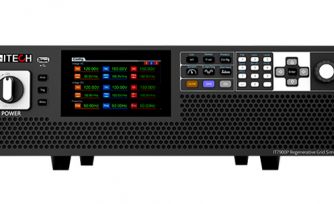
Taking the ITECH IT7900P Series as an example, programmable grid simulators offer the following advantages:
1). All-in-One Testing Platform
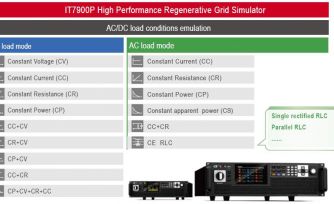
The IT7900P integrates grid simulation, AC power supply, and regenerative
load into a single unit, supporting full four-quadrant operation.
Users can perform multiple test tasks without switching equipment,
significantly improving efficiency and utilization.
2). Flexible and Programmable Grid Emulation
Capable of simulating voltage and frequency fluctuations, harmonic/interharmonic injection, phase jumps, and low-voltage ride-through (LVRT).
Built-in waveforms comply with IEC 61000 standards and support custom waveform import, meeting global grid compliance requirements.
3). High-Efficiency Energy Regeneration
With SiC technology and regenerative design, energy from the DUT can be fed back to the grid with efficiency up to 91%, reducing both power consumption and cooling costs.
4). High Power Density and Scalability
Delivers 15 kVA in a 3U form factor and supports parallel expansion up to 960 kVA, suitable for both R&D labs and high-power production testing.
5). Rich Test Modes and Protection Mechanisms
Supports AC, DC, AC+DC, and DC+AC output modes.
Advanced functions include LIST, SWEEP, and Surge & Sag testing.
Built-in multiple protection mechanisms and software watchdog ensure DUT and system safety.
6). Intelligent Control and Remote Integration
Equipped with a touchscreen interface and PC software (PV7900P).
Supports multiple communication protocols (CAN, LAN, GPIB), enabling seamless integration into automated test systems.
3. Typical Application Scenarios
|
Field |
Test Items |
Implementation with IT7900P |
|
PV Inverters |
Anti-islanding, LVRT, harmonic immunity |
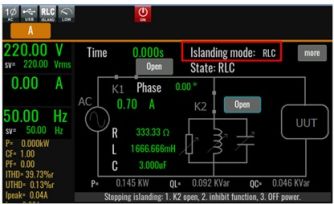
Built-in islanding modes, regulatory waveforms, programmable impedance |
|
Energy Storage (PCS) |
Charge/discharge efficiency, grid interaction |
Four-quadrant operation, energy regeneration, grid disturbance simulation |
|
Electric Vehicles |
V2G, charger efficiency, grid interaction |
Multi-channel output, three-phase and reverse-phase modes |
|
Power Electronics |
UPS, inverters, generators |
Programmable voltage/frequency variations |
4. Technical Highlights of the IT7900P Series
- SiC Technology: Improved efficiency and power density
- Phase Locking Function: Supports 6-phase / 12-phase simulation
- Data Logging & Harmonic Analysis: Continuous recording with up to 50th harmonic measurement
- Multi-Channel Independent Testing: Simultaneous testing of up to 3 DUTs, increasing throughput
5. Conclusion
Programmable grid simulators are more than just testing tools—they are essential infrastructure for advancing power electronics innovation.
By providing a highly integrated, programmable, and energy-efficient platform, they enable engineers to build realistic, controllable, and repeatable test environments across R&D, certification, and production stages.
This accelerates time-to-market while improving system reliability.
The ITECH IT7900P Series, with its advanced architecture and powerful simulation capabilities, has become a core solution for testing in renewable energy, electric vehicles, and energy storage systems—helping companies meet the challenges of future power grids.