EV Battery Voltage Ripple and Immunity Testing — Testing Challenges and ITECH Solutions for 400V/800V Platforms
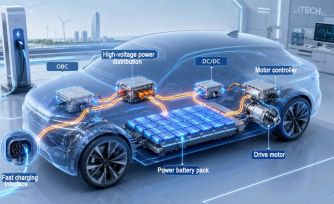
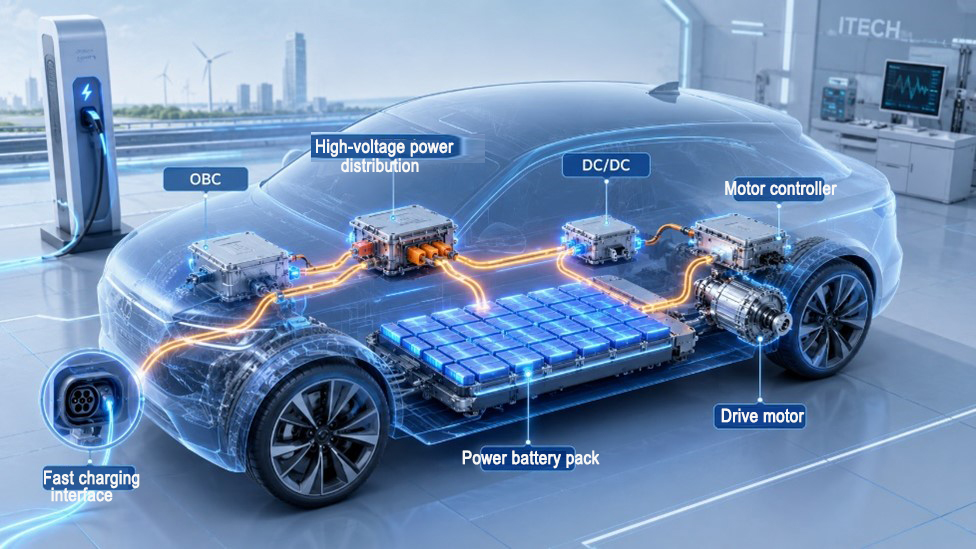
As new energy vehicles continue to evolve toward higher-voltage and platform-based architectures, 400V/800V battery systems have become a key direction in vehicle electrical system development. While high-voltage platforms improve charging efficiency, reduce system losses, and enhance overall vehicle performance, they also place higher demands on the electrical stability of core components such as battery packs, DC/DC converters, and onboard chargers (OBCs).
As new energy vehicles continue to evolve toward higher-voltage and platform-based architectures, 400V/800V battery systems have become a key direction in vehicle electrical system development. While high-voltage platforms improve charging efficiency, reduce system losses, and enhance overall vehicle performance, they also place higher demands on the electrical stability of core components such as battery packs, DC/DC converters, and onboard chargers (OBCs).
During vehicle operation, the high-voltage DC bus is affected by components such as motor controllers and inverters, generating voltage ripple with varying frequencies and amplitudes. If the device under test has insufficient immunity capability, it may lead to abnormal alarms, output fluctuations, unintended protection triggering, or even impact overall vehicle operational safety. Therefore, battery voltage ripple and immunity testing has become an essential part of high-voltage component validation for new energy vehicles.
Note: Relevant testing can refer to standards such as ISO 21498 and VW 80300. Test items include DC power supply voltage variation, voltage slope and immunity, voltage ripple and immunity, overvoltage and undervoltage, voltage offset, load dump voltage and immunity, among others.
Typical Case Analysis of Battery Voltage Ripple and Immunity Testing
Test Purpose:
To verify whether the device under test (such as a DC/DC converter or onboard
charger) can continue operating stably without being affected when AC ripple
interference generated by other components (such as motor controllers) exists
on the high-voltage DC bus.
Test Requirements:
- Test frequency: 10Hz ~ 300Hz
- Operating voltage: 400 ~ 800V
- Vpp amplitude: minimum 10Vpp, maximum 100Vpp
Testing Challenges:
One key characteristic of ripple testing for battery packs is that the test
must be performed in CC (constant current) mode, and the ripple is superimposed
on the battery’s own voltage.
The system must not only generate a clean sine-wave ripple of at least 100Vpp within the 10–300Hz frequency range on top of a 400–800V DC bias, but also precisely superimpose the ripple onto the output current in CC mode, thereby indirectly generating voltage ripple across the battery terminals.
ITECH Solution:
IT6600C Bidirectional DC Power Supply with analog control.
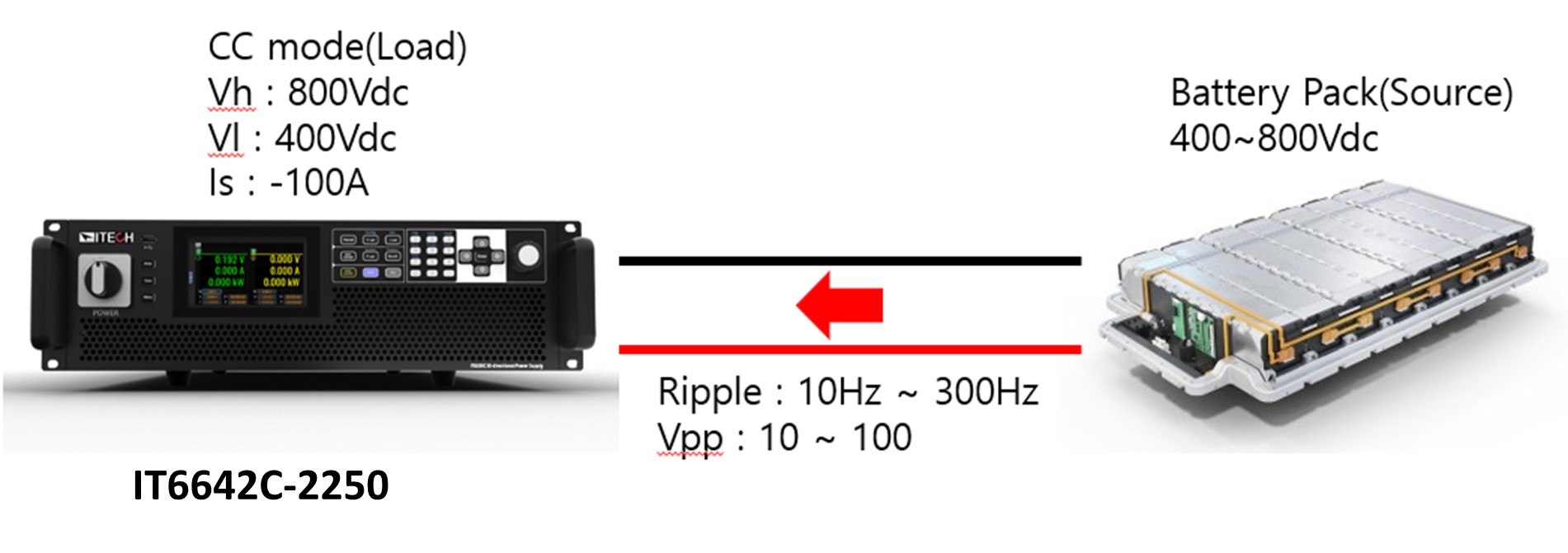
ITECH utilizes the analog control functionality of the IT6600C bidirectional programmable DC power supply, combined with an external signal generator, to enable ripple injection testing at different frequencies and amplitudes.
This solution can be used to simulate real interference conditions in the high-voltage bus of new energy vehicles, helping engineers quickly verify the stability and immunity of high-voltage components such as battery packs, DC/DC converters, and onboard chargers (OBCs) under complex electrical conditions.
The following is a schematic diagram of battery ripple superposition under CC mode.
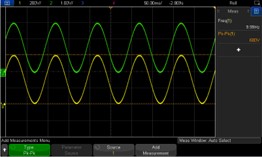
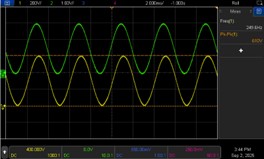
analog 600V 10Hz analog 600V 250Hz
ITECH Solution Advantages:
Ø High-voltage platform compatibility
Supports testing requirements for 400V/800V high-voltage systems, suitable for
validation of new energy vehicle battery packs and high-voltage components.
Ø Flexible ripple signal superposition
By using the analog input interface to import ripple waveforms generated by a
signal generator, different frequencies, amplitudes, and waveform conditions
can be configured according to test requirements.
Ø Closer to real operating conditions
Supports ripple testing in CC (constant current) mode, which better reflects
the actual operating state of the battery pack on the vehicle high-voltage DC
bus.
Ø Improved validation efficiency
Helps R&D, test, and quality validation teams quickly build test
environments and complete multi-scenario testing, from standard compliance
verification to extreme condition evaluation.
Summary:
With the development of 800V fast charging, upgrades in power semiconductors,
and increasing complexity of vehicle electrical architectures, the stability of
high-voltage components under disturbance conditions has become a key
performance indicator in product validation. Focusing on core applications such
as EV batteries, OBCs, DC/DC converters, and motor controllers, ITECH continues
to provide high-precision and high-reliability power testing solutions, helping
customers improve R&D validation efficiency and ensure stable operation
under complex working conditions.