Establishing a Stable Input Reference for AC-Side Testing of AI Server PSUs: ITECH IT7900EP High-Performance Grid Simulator
Introduction The power density of AI servers is increasing rapidly. Rack-level power consumption is evolving from tens of kilowatts in traditional servers to over 100 kW, and power architectures are transitioning from 48 V systems to 800 V HVDC. In this process, AC-side testing of AI server power supply units (PSUs) faces new requirements:
- Dynamic load: GPU loads can shift from 10% to 100% within microseconds
- Inrush current: large input capacitors can generate inrush currents several times the rated value
- Efficiency testing: increasing data center PUE requirements demand higher accuracy in efficiency measurement
These requirements lead to a fundamental need: the AC input source must be stable enough not to introduce measurement error.
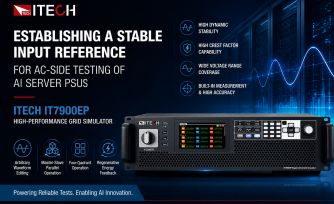
The ITECH IT7900EP high-performance grid simulator is designed to meet this requirement by providing a clean, controllable, and repeatable AC input reference, allowing engineers to focus on the performance of the device under test rather than limitations of the test equipment.
1. “Reference Source” Requirements for AI Server AC Testing
1.1 Output stability under dynamic load
AI server power waveforms exhibit high di/dt characteristics. If the test equipment itself produces output fluctuations during load transients, it becomes impossible to distinguish whether the variation comes from the DUT or the source. The IT7900EP series provides stable output for laboratory testing.
1.2 High crest factor capability: handling inrush current
During startup, AI server PSUs generate inrush currents several times their rated current. The AC source used for testing must support a high crest factor to prevent waveform distortion during these events.
1.3 Wide voltage range: compatibility with current and next-generation architectures
|
Architecture |
Data Center Input |
Rated Input Voltage |
Module Power Level |
|
Traditional 480 V rack (12 V bus) |
3-phase 400 VAC (line-line) |
208/220 VAC |
3–3.3 kW |
|
ORV3 / ORV3-HPR (OCP AI architecture, 50 V bus) |
3-phase 400–480 VAC |
277 VAC (NA) / 230 VAC (CN) |
3 kW / 5.5–8 kW / up to 12 kW |
|
RUBIN full-rack architecture |
480 VAC power distribution |
277 VAC |
5.5 kW per GPU node, 132 kW+ per rack |
|
HVDC (±400 V / 800 V DC bus) |
400/480/690 VAC front-end |
480 VAC line voltage |
15–30 kW per rectifier module |
The IT7900EP family offers models with 350 V, 700 V, and 1050 V VL-N rated output, covering evolving testing requirements across different architectures.
2. Built-in Measurement: Reducing Test Chain Errors
Efficiency testing is a core validation item for AI server PSUs. Conventional test setups require external power analyzers, introducing additional cabling and synchronization errors.
The IT7900EP integrates a multi-channel power measurement system:
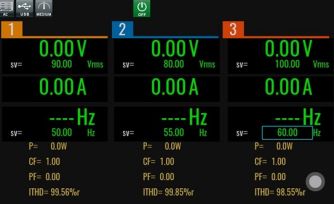
- Synchronous measurement of voltage and current
- Real-time calculation of active power, apparent power, and power factor
- Display supports up to 6 waveform traces simultaneously
- Data logging via PC or USB export
This integration reduces system complexity and minimizes error sources.
3. Arbitrary Waveform Editing: Custom Test Scenarios
The IT7900EP series supports user-defined waveform import via CSV files. Typical applications include:
- Grid waveform reproduction: importing recorded grid waveforms for real-world validation
- Boundary condition testing: defining voltage and frequency combinations beyond standard limits
- Harmonic injection testing: evaluating immunity to specific harmonic components
This enables fast replication of real operating conditions and improves development efficiency.
4. Master-Slave Parallel Operation: Power Scaling
When test requirements exceed a single unit’s capacity, the IT7900EP supports master-slave parallel operation. Multiple units are synchronized via digital communication.
- 3U system provides up to 21 kVA high power density
- Scalable up to 10 MVA system level
- Maintains voltage range and waveform quality
- Unified control interface for the entire system
This provides a scalable path from single-module to rack-level testing.
5. Role of the Grid Simulator
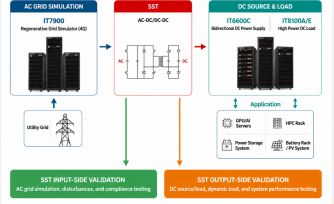
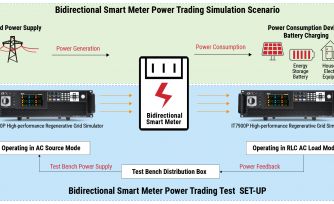
In practical testing, the IT7900EP grid simulator also provides bidirectional energy capability beyond conventional AC sources.
With increasing power demand in AI data centers, coordination with grid systems becomes critical. As renewable energy penetration increases, it is necessary to evaluate the interaction between AI server loads and renewable generation systems. In these cases, a full four-quadrant grid simulator is required.
The IT7900EP operates not only as a high-power AC source, but also as a grid simulator, four-quadrant power amplifier, and regenerative AC/DC electronic load. It supports built-in programmable RLC functions and is suitable for grid interconnection testing such as IEEE 1547 and UL 1741.
Its regenerative capability feeds energy back to the grid, reducing energy consumption and cooling costs. With a modular high-efficiency design, a single 3U unit delivers up to 21 kVA, and parallel operation can scale beyond 10 MVA.
Conclusion
AC-side testing of AI server power supplies places significantly higher demands on input source stability compared to traditional servers. The IT7900EP high-performance grid simulator is designed to provide a deterministic and low-disturbance AC input reference, enabling accurate evaluation of PSU performance.
For detailed configurations or test demonstrations, visit: https://www.itechate.com/