|
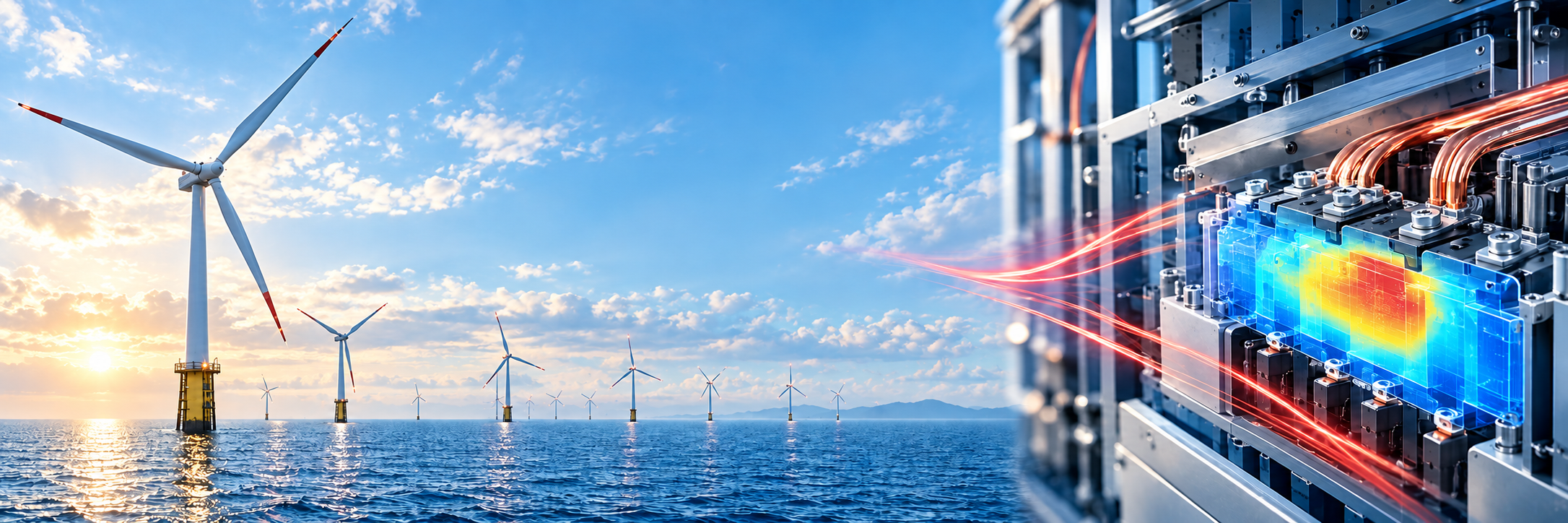
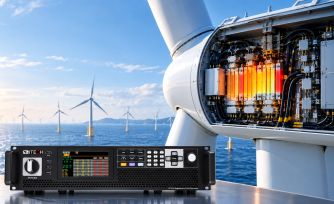
In June 2026, the Global Wind Energy Council (GWEC) released its Global Offshore Wind Report 2026. According to the report, global offshore wind additions reached 9.3 GW in 2025, up 16% year over year, while the average offshore turbine rating exceeded 10 MW for the first time, reaching 10.3 MW.
Beyond capacity growth, the continued scaling of wind turbines is placing greater emphasis on the thermal reliability of converter power modules.
01 Larger Turbines Push Reliability Challenges Toward the Power Module
Wind power converters are critical power-electronic systems connecting the generator to the grid. They perform energy conversion, power regulation, and grid-support functions.
As turbine ratings and power density continue to increase, power semiconductors, busbars, terminals, magnetic components, and cooling systems are exposed to higher current and thermal stress.
For offshore wind applications, equipment must also operate under demanding environmental conditions such as high humidity, salt mist, vibration, and limited maintenance windows.
A localized hotspot or abnormal contact resistance can accelerate insulation aging, material fatigue, and component performance drift, ultimately affecting turbine availability.
For this reason, thermal-rise validation should not simply answer the question: “Will the equipment get hot?” It should address three more important engineering questions:
-
Where do hotspots occur?
-
How long does the system take to reach thermal equilibrium?
-
Is the design margin sufficient to accommodate long-term operation and manufacturing variation?
From R&D prototypes to design verification and batch-consistency checks, thermal-rise testing has become an important method for evaluating current-carrying capability, heat-dissipation paths, and assembly quality.
The more stable and repeatable the test results are, the more reliable the data becomes for structural optimization, material selection, and lifetime assessment.
02 The Challenge of Thermal-Rise Testing Is More Than Delivering High Current
ITECH Perspective
The core objective of thermal-rise testing is not simply to achieve the highest possible current. It is to continuously and accurately reproduce the target thermal stress while ensuring that results remain comparable across different prototypes, production batches, and laboratories.
Several factors are critical.
Long-Term Stable Loading
Thermal-rise testing typically needs to continue until the DUT approaches thermal equilibrium. Any drift in current, frequency, or supply conditions can alter power losses and increase the variation in final temperature-rise results.
Clearly Defined Test Boundaries
Ambient temperature, cooling medium, contact resistance, cable losses, and temperature-measurement locations can all affect the result. Only when these boundaries are clearly defined can the test data be used reliably for engineering decisions.
Repeatability Across Multiple Tests
R&D comparisons, batch validation, and failure investigation all require consistent operating profiles. Simply reaching a target current once does not create a repeatable and comparable validation methodology.
Safety and Scalability
Low-voltage, high-current testing places greater demands on cabling, heat dissipation, and protection. The test platform must remain stable across different power levels and provide clearly defined protection boundaries for abnormal operating conditions.
03 ITECH Solution: Reproducing Equivalent Thermal Stress with a Controllable Source
For converter power-module thermal-rise validation, ITECH recommends shifting the test objective from “reproducing the complete converter” to “reproducing the equivalent electrical stress associated with heat generation.”
By combining a programmable power source, the required voltage/current adaptation stage, and independent temperature acquisition, engineers can establish a clearly defined validation environment at the component level.
This approach also avoids mixing converter control functions, grid-interconnection behavior, and thermal validation into a single test setup.
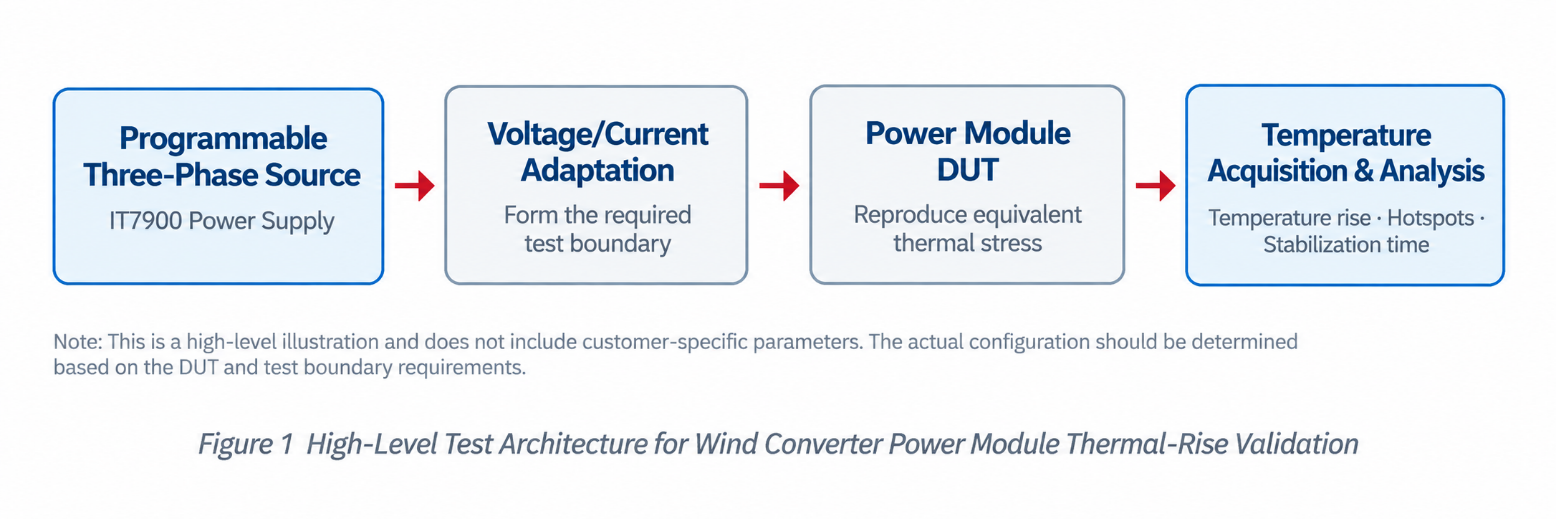
In this architecture, the grid simulator provides a stable and programmable source-side power boundary.
The low-voltage, high-current condition is created by the complete test system according to the DUT requirements, rather than being generated directly by the grid simulator itself.
Engineers can build a test matrix around:
-
Rated operating conditions
-
Overload conditions
-
Thermal stabilization time
-
Hotspot distribution
Source-side operating records can then be correlated with temperature curves, improving data traceability and supporting more reliable analysis.
04 The Role of the IT7900 Grid Simulator in Thermal-Rise Testing
The IT7900 series is a programmable, full four-quadrant regenerative grid simulator capable of single-phase or three-phase AC output.
It supports functions such as current limiting, power limiting, waveform measurement, and trend recording.
In power-module thermal-rise testing, its key value is not simply the number of general-purpose functions it offers. More importantly, it provides a stable source-side boundary for long-duration loading while preserving scalability for test systems at different power levels.
Key IT7900 Capabilities for Thermal-Rise Validation
|
IT7900 Capability
|
Customer Value in Thermal-Rise Testing
|
|
Programmable three-phase AC output
|
Provides a stable and repeatable source-side power boundary for long-duration loading
|
|
Current and power limiting
|
Helps define test stress and provides essential system protection under abnormal conditions
|
|
High power density and modular scalability
|
Reduces test-system footprint and supports validation across different power levels
|
|
Built-in measurement, waveform, and trend recording
|
Preserves source-side operating data for temperature-data review and anomaly analysis
|
Using the IT7930-350-180 as an example, its standard rating is 350 V (L-N), 180 A, and 30 kVA.
Its output current already exceeds that of many conventional laboratory AC power sources. With its built-in constant-current capability, it can also support AC constant-current operation in suitable test configurations.
In practical applications, the system can be configured according to test power, phase requirements, and DUT boundaries, then combined with the necessary adaptation stage to create the required low-voltage, high-current condition.
This layered architecture clearly separates instrument capability, system-level capability, and DUT test requirements. It also makes the platform easier to scale and reuse for future validation needs.
For thermal-rise scenarios dominated by passive loading, the test system should prioritize continuous output capability, test protection, repeatability of operating conditions, and data consistency.
For applications involving bidirectional power flow, such as grid-connected converters, energy-storage systems, or power hardware-in-the-loop testing, the four-quadrant regenerative capability of the IT7900 can provide additional value.
From “Completing a Test” to “Building Reliable Evidence”
As the wind power industry moves from pure capacity growth toward competition in reliability and lifecycle cost, test systems must do more than simply push a product to its target operating point.
They must reproduce operating conditions continuously, controllably, and repeatably, providing trustworthy evidence for engineering decisions.
With the IT7900 series and its broader portfolio of power test solutions, ITECH can support different power levels and validation objectives, from source-side power delivery to system integration.
This helps improve thermal-rise validation efficiency, data consistency, platform scalability, and test-system reuse.
Learn more about ITECH’s full range of high-performance test solutions:
Contact: info@itechate.com
|