|
The Global Market Is Moving from Flight Demonstrations to Certifiable Operations
Terminology varies by region. In North America and Europe, the market is commonly discussed in terms of Advanced Air Mobility (AAM), Innovative Air Mobility (IAM), and Unmanned Aircraft Systems (UAS). China uses the broader term low-altitude economy to encompass aircraft manufacturing, infrastructure, flight services, and commercial applications. The direction is nevertheless consistent: the industry benchmark is shifting from completing a one-time flight demonstration to proving that aircraft can operate safely, consistently, and at scale. The FAA issued its final powered-lift rule in 2024. In 2025, EASA published operational means of compliance and guidance for piloted VTOL-capable aircraft and granted the first type certificate for an electric aircraft engine under SC E-19. In the same year, CAAC issued the first operating certificates for passenger-carrying civil uncrewed aircraft. As certification, production, and operational frameworks converge, electrical validation must evolve from component performance checks into lifecycle evidence supporting design assurance, production consistency, and continued airworthiness.
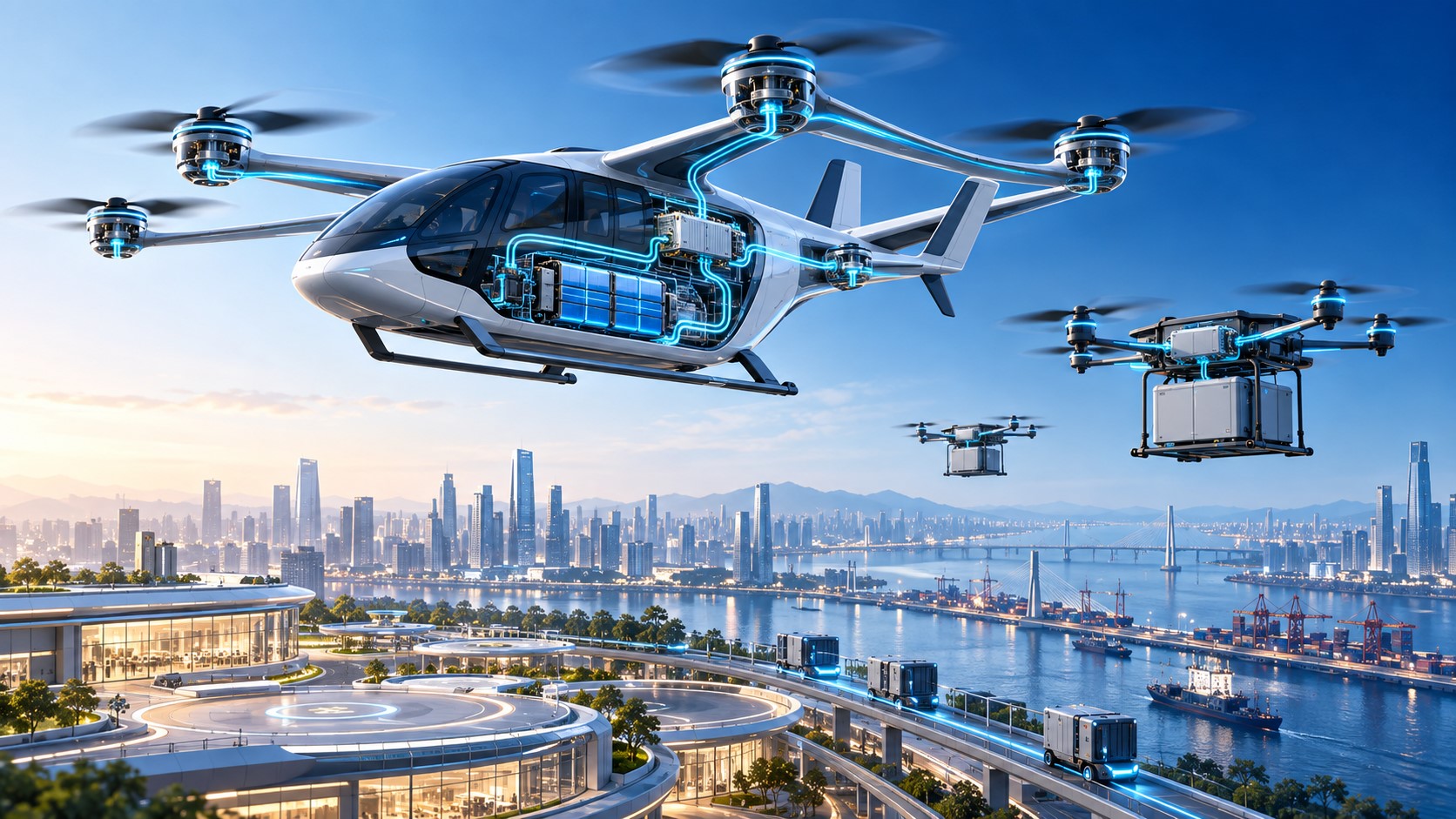
For test engineers, this transition changes the central question. It is no longer sufficient to demonstrate that a system can deliver peak power under nominal conditions. The power architecture must remain controlled at low temperature and low state of charge, with aged components, communication interruptions, and localized faults. Efficiency results must be accompanied by dynamic waveforms, protection timing, and raw data that can be reproduced and audited. For low-altitude aircraft, the power and electronic systems form a critical path linking range, safety, dispatch availability, and operating economics.
Technology Evolution Is Driving Higher Voltage Faster Dynamics and More Channels
Battery-electric, hybrid-electric, and hydrogen-electric architectures continue to develop in parallel. High-specific-energy cells, fast charging, high-voltage DC buses, SiC power devices, and distributed electric propulsion can reduce cable mass and improve system efficiency, but they also increase electrical-system complexity. Takeoff and hover demand high short-duration power, while cruise emphasizes efficiency. Descent, braking, and windmilling propellers can return energy to the DC bus. Low temperature, low SOC, and battery aging raise internal resistance and can amplify bus-voltage sag and ripple. As a result, transient interactions among the battery pack, motor controller, DC-DC converter, actuators, and avionics are often more difficult to validate than the steady-state performance of any individual component.
Distributed architectures also introduce more loads across a wider range of power levels. Flight-control computers, communications and navigation systems, sensors, lighting, pumps, fans, servos, and auxiliary motors may operate from different voltage rails and may impose strict requirements for power sequencing, standby consumption, and transient immunity. Electrical testing must therefore cover both tens-of-kilowatts propulsion buses and watt-to-kilowatt electronic subsystems that require synchronized multi-channel power, precision measurement, and waveform capture. Constant-voltage sourcing or constant-current discharging alone cannot reproduce a representative flight mission.
Six Electrical Test Challenges That Define Platform Capability
1 Reproducing Mission Profiles
For battery-powered aircraft, dynamic power testing begins with operating-profile simulation at the battery interface. Waveforms should cover power-up self-test, vertical takeoff, hover, cruise, abrupt maneuvering, descent, landing, and fast charging, with temperature, SOC, SOH, and cell-to-cell variation superimposed. Current slew rate, minimum pulse width, waveform playback, and synchronized triggering directly affect the credibility of peak-current, bus-voltage-stability, and protection-timing results.
2 Applying Controlled Cell and BMS Faults
Validation must extend beyond measurement and balancing accuracy to overvoltage, undervoltage, overcurrent, insulation faults, temperature offsets, sense-line opens, short circuits, and reverse polarity. The test platform must independently control voltage and current across multiple channels and capture the response sequence of contactors, alarms, derating functions, and backup power paths. This is essential for determining whether redundancy works as intended.
3 Characterizing the High-Voltage DC Bus in Steady State and Transient Operation
Higher bus voltages and faster switching edges can introduce overshoot, ripple, common-mode interference, and control-loop stability issues. A battery simulator must reproduce open-circuit voltage and internal resistance across SOC and temperature. The electronic load must recreate pulsed power demand, while measurement instruments correlate voltage, current, and control signals on a common time base.
4 Managing Bidirectional Energy Flow in Auxiliary Motors and Actuators
Pumps, fans, servos, and other auxiliary motors can produce high inrush current, regenerative bus energy, or back EMF during startup, stall, rapid acceleration and deceleration, and braking. The test source must deliver stable power, absorb returned energy, and emulate output impedance and battery characteristics without allowing an external dissipation stage to distort the behavior of the device under test.
5 Powering and Measuring Multi-Rail Avionics with Precision
Flight-control, communications, navigation, sensor, and DC-DC modules often require coordinated power rails. Relevant measurements include microampere-level standby current, power-up sequencing, inrush current, hold-up behavior, and millisecond- or microsecond-scale transients. When sourcing, scope capture, and data logging are distributed across separate instruments, trigger skew and wiring complexity can reduce result consistency.
6 Maintaining Efficiency and Traceability in Long-Duration Testing
HPPC, DCIR, cycle-life, thermal-management, and mission-profile endurance tests can run for extended periods and process substantial energy. Regenerative equipment returns absorbed energy to the AC mains, reducing facility power and cooling demand. Automation software can preserve procedures, limits, exception handling, raw data, and report templates, giving design verification and production test a consistent decision baseline.
ITECH Test Solutions for Advanced Air Mobility
ITECH instruments can be configured to address different power levels and validation objectives.
|
Test Object
|
Key Test Requirements
|
ITECH Solution Value
|
|
Cells and BMS
|
Cell-to-cell variation, balancing, protection, and fault injection
|
IT2600 Multi-Channel Battery Cell Simulator and Test Platform: independent cell-voltage and current control, battery models, cycling tests, and open-circuit, short-circuit, and reverse-polarity fault simulation.
|
|
Battery Pack and Propulsion DC Bus
|
SOC/SOH variation, startup sag, peak power, and regenerative energy
|
IT6600C Bidirectional DC Power Supply with BSS2000: 42 kW in 3U, independent dual-channel architecture, battery simulation, and high-power source/sink testing.
|
|
Propulsion Power and Motor Controller
|
Fast pulses, low-voltage/high-current operation, and dynamic stability
|
IT8100A/E High-Speed DC Electronic Load: 50 kHz dynamic operation and up to 150 A/μs current slew rate for rapid load transients.
|
|
Auxiliary Motors and Electronic Subsystems
|
Startup, stall, regenerative braking, DC-DC converters, and auxiliary power
|
IT-M3900C Bidirectional DC Power Supply: up to 6 kW in 1U and 12 kW in 2U, integrated source/sink operation, and battery simulation for flexible subsystem test benches.
|
|
Precision Multi-Rail Electronics
|
Multiple rails, power sequencing, low-current measurement, and transient capture
|
IT2705 DC Power Analyzer: eight channels per mainframe and scalable to hundreds of channels; DC source, bidirectional source, regenerative load, and SMU modules with Meter, Scope, and Data Logger functions.
|
|
Ground Power and Charging Equipment
|
Voltage dips, interruptions, frequency variations, harmonics, and bidirectional power flow
|
IT7900P Four-Quadrant Grid Simulator with APS4000 Power Simulation Software: reproduces AC input disturbances and also supports AC motor testing.
|
From Component Validation to a Closed Loop System Test Strategy
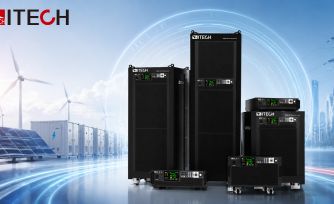
Based on ITECH solutions for the low-altitude economy and UAV testing, laboratories can build a layered platform spanning cell and BMS validation, battery-pack and DC-bus emulation, propulsion and auxiliary loads, avionics electronics, and charging and ground power. The IT2600 supports cell-level and BMS validation. The IT6600C with BSS2000 reproduces battery-pack behavior on medium- and high-power DC links. The IT8100A/E applies high-speed dynamic loading. The IT-M3900C addresses bidirectional testing of auxiliary motors, actuators, and DC-DC converters. The IT2705 provides precision multi-channel sourcing, sequencing, and transient measurement. On the AC side, the IT7900P reproduces supply disturbances and characterizes input behavior.
Advancing Electrical Validation for Low Altitude Aircraft
ITECH specializes in power-electronics testing, with a portfolio spanning bidirectional DC source and sink systems, high-speed electronic loads, multi-channel battery-cell simulation, precision DC power analysis, AC grid simulation, power analysis, and automation software. For low-altitude aircraft programs, these capabilities convert high-voltage operation, fast transients, multi-rail precision power, and safety-fault scenarios into executable, repeatable, and traceable test workflows. Modular and scalable system architectures help engineering teams carry validated methods from early R&D through design verification and production test. Learn more on the ITECH website.
|