EIS Testing Applications for Cells/Battery Modules
Electrochemical Impedance Spectroscopy (EIS) is an analytical technique used to study the dynamic characteristics and interfacial phenomena of electrochemical systems by measuring their impedance response under AC excitation at different frequencies. In essence, it provides both a “fingerprint” and a “health check” for batteries.
In battery manufacturing, R&D companies, and research institutes, EIS testing is widely applied to:
- Identify capacity fading mechanisms through frequency-domain characteristics
- Rapidly estimate the state of health (SOH)
- Screen out risky cells/modules
- And guide decisions on the most suitable application scenarios (e.g., energy storage, low-speed vehicles, UPS, etc.).
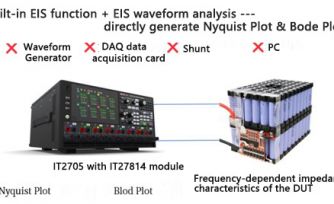
The ITECH IT2705 mainframe, when equipped with the multi-channel SMU module IT27814, features a built-in EIS testing function that automatically generates Nyquist and Bode plots. By capturing subtle responses under multi-frequency excitation (0.01 Hz to 20 kHz), it reveals potential issues that are difficult to detect with conventional methods. The results, visualized through Bode and Nyquist plots, are particularly valuable in processes such as second-life utilization and remanufacturing of power batteries—for example, in incoming material pre-screening, standard scans, module matching, and final acceptance testing.
IT27814: The Industry’s First Module with Built-in EIS Function
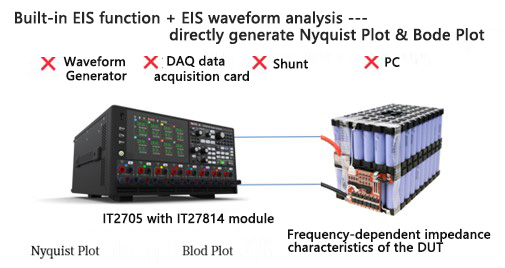
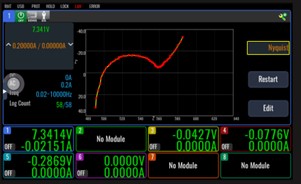
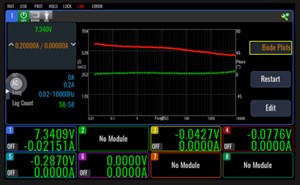
Nyquist Plot Bode
Plot
IT2705+IT27814 Source Meter Module Testing Advantages
- Up to 8 channels per IT2705 mainframe, with flexible slot-in of SMU modules (IT27814), DC power supplies, or regenerative loads to complete an all-in-one workflow for EIS + ACIR + capacity/endurance testing.
- Combines charge and discharge functions with EIS testing for one-stop testing, eliminating synchronization errors and routing errors caused by splicing multiple instruments.
- Frequency scan range: 0.01 Hz to 20 kHz.
- High precision with nA-level measurement accuracy and µs-level dynamic response speed.
- Multi-channel parallel EIS in minutes, enabling efficient pre-screening and shortened test cycles.
- Direct Nyquist/Bode plotting, making it convenient to extract RΩ, Rct, and low-frequency diffusion features for grading.
- Parallel multi-channel EIS within a single frame, with unified triggering/power-on sequencing—ideal for incoming material pre-screening and batch grading.
- Four-wire Kelvin measurement, remote sensing, and channel isolation.
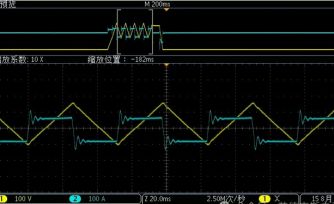
- Built-in high-sampling oscilloscope monitoring (up to 200 kHz) on the IT2705, allowing simultaneous observation of transients such as cold starts or voltage drops under EIS operating conditions.