New Approaches to High-Voltage Capacitor Fast Charge/Discharge Testing — The Multi-Role IT6600C Bidirectional DC Power Supply
High-voltage, high-power capacitors are key components in modern power systems. Market demand continues to grow, driven by the rapid development of renewable energy generation (wind and solar), electric vehicles, smart grids, and industrial variable-frequency equipment. These capacitors must offer high voltage endurance, large capacitance, low loss, and high reliability to support critical functions such as energy storage, filtering, and reactive power compensation.
As the global energy transition accelerates and power electronics technologies advance, high-voltage, high-power capacitors show enormous application potential in renewable energy, new energy vehicles, charging infrastructure, and rail transit. High-performance, long-life capacitor products are increasingly favored by the market.
High-voltage, high-power capacitors must withstand high-frequency, high-current charge and discharge cycles. Dynamic condition testing is essential to verify their response speed and energy support capability under extreme operating conditions, and to evaluate lifetime and reliability. In fast charge/discharge testing of capacitors, the DC power supply plays a critical role.
The important role of DC power supply
1. Providing a Stable Charge/Discharge Energy Source
Charging Phase: The DC power supply provides a stable voltage or current to the capacitor, ensuring rapid charging to the target voltage. In constant-current (CC) mode, the power supply delivers high current to shorten charging time; in constant-voltage (CV) mode, it maintains precise voltage levels to prevent overcharging.
Discharging Phase: While discharging is usually performed via an external load, certain tests may require a bidirectional DC power supply to absorb reverse current (e.g., for energy recovery systems), simulating energy cycling in real applications.
2. Precise Control of Charge/Discharge Parameters
Dynamic Response: Fast charge and discharge require the power supply to respond within milliseconds or even microseconds to support high-frequency switching. For example, in pulse power applications, the power supply must deliver large current instantaneously and adjust output rapidly.
Mode Switching: Quick switching between CC and CV modes ensures charging efficiency while preventing overvoltage damage to the capacitor.
3. Protection and Safety Features
Overvoltage/Overcurrent Protection: Real-time monitoring of voltage and current prevents capacitor damage under abnormal conditions such as short circuits or overcharging.
Thermal Management: Efficient heat dissipation ensures reliable operation during frequent charge/discharge cycles and prevents performance degradation or failure due to overheating.
4. Low Output Impedance and Efficient Energy Transfer
Low output impedance reduces energy loss during charging, improving overall efficiency. This is particularly important for high-capacitance or low-ESR (equivalent series resistance) capacitors.
5. Data Monitoring and System Integration
Real-Time Monitoring: Connection with data acquisition systems via communication interfaces (e.g., SCPI, Modbus) allows recording of voltage, current, and timing curves during charge/discharge, enabling performance analysis such as capacitance, internal resistance, and cycle life.
Programmable Control: Supports automated test sequences and complex charge/discharge waveforms (e.g., stepped charging, pulse sequences), simulating real-world application scenarios.
6. Simulation of Real-World Conditions
For specific applications such as electric vehicles or renewable energy systems, the DC power supply can emulate actual power source characteristics (e.g., battery dynamic response, grid fluctuations) to verify capacitor performance in realistic environments.
7. Support for High Power and High Voltage Requirements
High-power supplies meet the large current demands of rapid charging (e.g., kiloampere-level currents for supercapacitors), while high-voltage supplies are used to test the voltage endurance of high-voltage capacitors in energy storage applications within power electronics.
ITECH bidirectional DC power supplies are not only the core energy source in fast capacitor charge/discharge testing but also critical for ensuring test accuracy, safety, and repeatability. Their performance—dynamic response, stability, and protection features—directly impacts the reliability of test results, providing essential data for capacitor design and application.
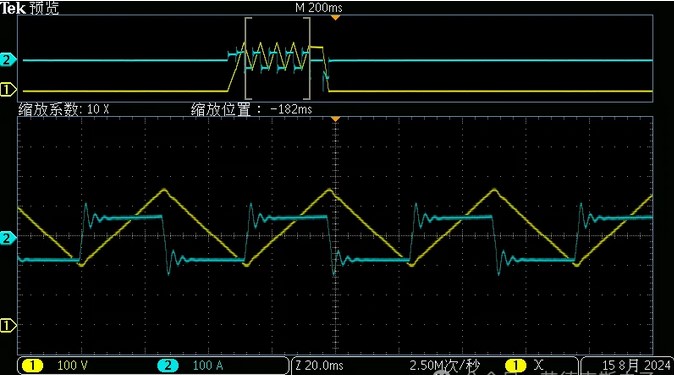
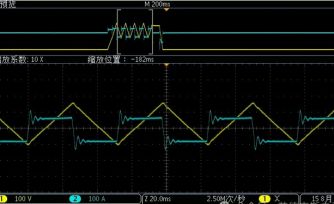
Measured charging and discharging waveforms of IT6600C
The ITECH IT6600C Series high-power bidirectional DC power supply features an ultra-high power density of 3U/42 kW and a voltage range of up to 2250 V. The 1200 V/42 kW model offers a 200 µs dynamic response time, enabling rapid switching between current-source and voltage-source modes, and supporting triangular-wave voltage charge/discharge operation as shown above.
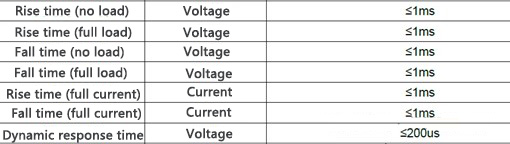
The ITECH IT6600C Series high-power bidirectional DC power supply is not just a power source—it is also an excellent load simulator. It can function as a DC power supply to deliver power, as well as a DC electronic load to absorb power and feed clean energy back to the grid, enabling energy recycling. As a powerful, user-friendly, and energy-efficient bidirectional programmable DC power supply, the IT6600C Series provides a new experience for high-power, complex applications in automotive, energy storage, industrial, and green energy fields, while offering strong support for R&D, validation, and production.