Evolution of AI Data Center Power Architectures and Testing Challenges: Insights from OCP APAC Summit 2026
From August 11 to 12, 2026, OCP APAC Summit was held at Nangang Exhibition Center in Taipei. With the theme “Leading the Future of AI,” the summit focused on AI clusters and computing, data center infrastructure, advanced packaging, and other emerging technologies.
As one of the most influential open standards organizations in the global data center infrastructure sector, OCP’s annual summit is widely regarded as an indicator of future data center technology trends. At this year’s summit, changes in power architectures driven by rapidly increasing AI computing power became a key topic. From the sharp increase in rack-level power density to the accelerated adoption of 800V high-voltage DC (HVDC) bus architectures and the continued evolution of server power supply unit (PSU) standards, the entire power delivery chain is undergoing significant changes.
The large-scale development of AI and HPC data centers is driving demand for advanced, highly integrated power and thermal management solutions. For the test and measurement industry, this means that traditional testing methods, test boundaries, and test equipment must also evolve.
1. Three Key Trends in AI Data Center Power Architecture
1.1 Rack Power Density: From Tens of Kilowatts to Hundreds of Kilowatts
The development of AI large models has driven GPU power consumption from around 400W per GPU to more than 1,000W. As a result, rack power density has increased from the tens-of-kilowatts range to tens or even hundreds of kilowatts.
At the OCP APAC Summit, several exhibitors demonstrated power testing solutions designed for high-power-density applications, indicating that this trend is moving from concept to engineering implementation.
Higher rack power density is not simply a numerical increase. It also means that the thermal density, current density, and transient load variations of power modules within a rack are increasing significantly. This places new requirements on power conversion efficiency, thermal management, and dynamic response.
Traditional testing has focused primarily on steady-state parameters. In high-power-density applications, however, transient characteristics, protection coordination, and system-level efficiency are becoming increasingly important test parameters.
1.2 Bus Voltage: From 48V to 800V HVDC
Over the past decade, 48V distributed power architectures have been widely used in data centers. However, as rack power exceeds tens of kilowatts, the large currents required by 48V systems create challenges related to power losses, busbar costs, and overall system efficiency.
800V high-voltage DC (HVDC) bus architectures are moving from standards discussions toward pilot implementation. Increasing the bus voltage can significantly reduce transmission current and power losses while reducing copper requirements and improving system efficiency.
However, 800V HVDC architectures also introduce new testing challenges. Higher voltage levels place more stringent requirements on the voltage withstand capability of test equipment. High-power bidirectional energy-flow testing, DC bus transient analysis, and protection strategy verification are becoming essential.
Test equipment must not only support a wide voltage range but also provide bidirectional energy handling capabilities to simulate bidirectional power flow, such as battery charging and discharging conditions.
1.3 PSU Standards: Toward Intelligent and Modular Architectures
The OCP Open Rack V3 (ORV3) standard has played an important role in promoting server power supply standardization. The industry continues to evolve at the Power Shelf and Power Rack levels, with integrated power cabinets moving toward higher power ratings.
PSU designs are also becoming more intelligent and modular, with higher conversion efficiency, more precise dynamic response, and more comprehensive digital monitoring interfaces becoming increasingly important.
These developments mean that power supply testing is no longer limited to individual devices. Instead, a complete testing chain is required, covering components through to system-level validation.
2. Key Challenges in High-Power Supply Testing
2.1 High-Power Bidirectional Energy-Flow Testing
In AI data center power systems, energy is no longer limited to one-way flow. With the integration of photovoltaic and energy storage systems, bidirectional energy flow is becoming increasingly common. Batteries can be charged during periods of low load and discharged during peak demand.
This requires test equipment to support bidirectional operation. Traditional combinations of unidirectional power supplies and dissipative loads are no longer sufficient for these applications. Bidirectional test equipment with energy recovery capabilities is becoming increasingly important.
At higher power levels, from hundreds of kilowatts to the megawatt range, bidirectional testing also needs to address challenges such as grid-connected power quality, current sharing among multiple units, and protection coordination.
2.2 MW-Level Parallel Operation and System-Level Validation
Once rack power reaches the hundreds-of-kilowatts range, power testing requirements for an entire AI cluster can reach the megawatt level. Since a single test instrument generally cannot cover MW-level requirements, multiple units must be connected in parallel.
MW-level parallel testing introduces several engineering challenges, including current-sharing accuracy, communication and synchronization delays, protection coordination, and system-level data acquisition and processing.
In addition, continuous MW-level testing can consume significant amounts of energy. With conventional dissipative loads, the resulting heat and electricity costs can become major constraints.
Energy-regenerative testing solutions can return absorbed energy to the grid rather than dissipating it as heat, making them particularly valuable for continuous high-power testing.
2.3 Dynamic Load and Transient Response Testing
AI workloads are characterized by rapid load changes. During transitions between GPU training and inference workloads, current can change by tens or even hundreds of amperes within microseconds.
Such transient load variations place stringent requirements on the dynamic response of the power delivery system.
Test systems must accurately reproduce these transient load profiles while capturing voltage and current response waveforms with sufficient bandwidth. This places demanding requirements on dynamic load slew rate, sampling bandwidth, and data processing capabilities.
3. ITECH MW-Level High-Performance Power Testing Solutions
To address the testing requirements resulting from the evolution of AI data center power architectures, ITECH provides capabilities in bidirectional regenerative testing and MW-level system solutions.
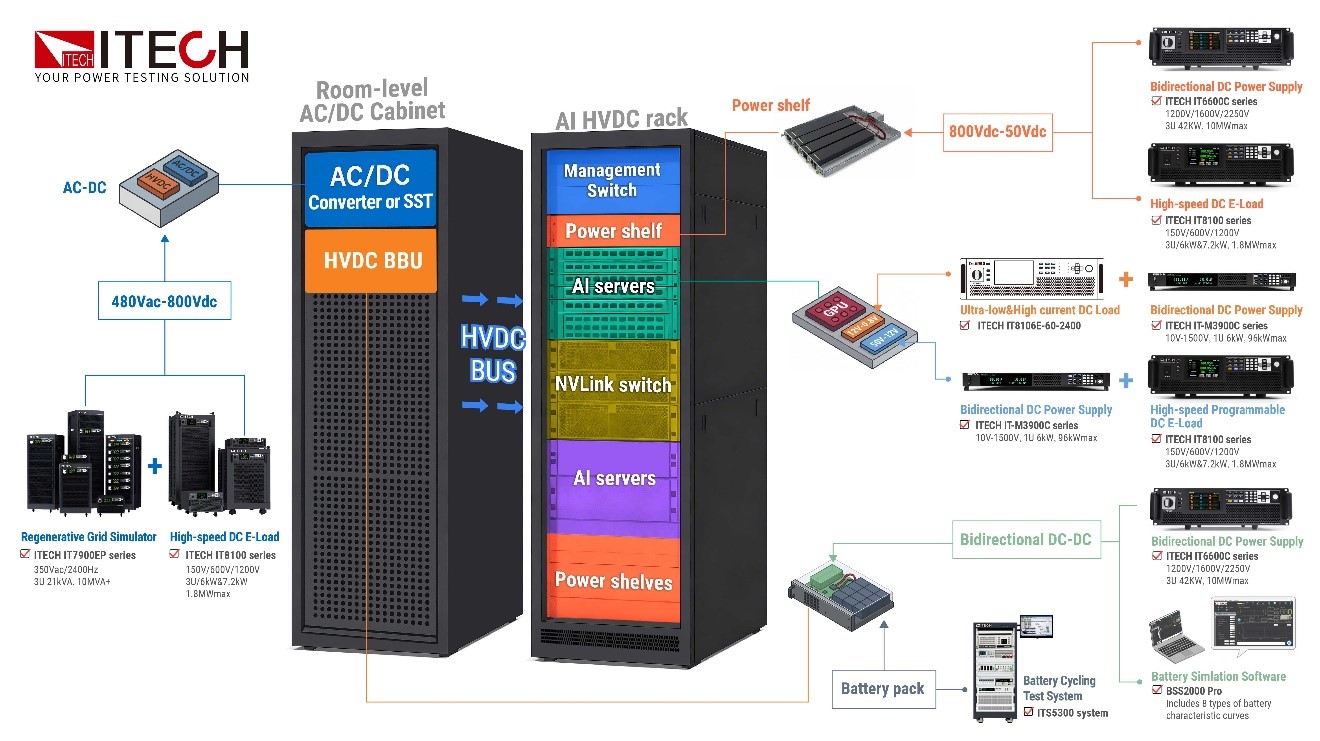
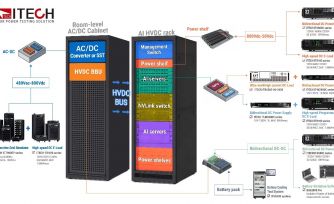
Figure 1. ITECH AIDC Testing Solution Architecture
ITECH provides not only individual test instruments but also integrated system-level testing solutions.
For AI data center power delivery testing, ITECH can provide a comprehensive testing solution covering applications from low-voltage VCORE testing to 800V DC bus testing, and from individual rack power validation to MW-level cluster power simulation.
The IT7900EP high-performance grid simulator, IT6600C bidirectional DC power supply, and IT8100A/E high-performance DC electronic load support MW-level multi-unit parallel operation. Combined with unified remote control interfaces, including SCPI, LAN, USB, and CAN, as well as integrated data capabilities, these products enable engineers to build complex system-level test configurations efficiently.
ITECH also has extensive experience in regenerative testing technologies, including grid-connected power quality control, current sharing among multiple units, and protection coordination. These capabilities support the safe and stable operation of MW-level test platforms.
4. Conclusion and Outlook
OCP APAC Summit 2026 highlighted a clear trend: AI data center power architectures are evolving from 48V to 800V HVDC and from tens of kilowatts to hundreds of kilowatts per rack.
This transformation is redefining the technical requirements for high-power electronic testing. From grid simulation and MW-level parallel operation to bidirectional energy regeneration and transient response testing, testing solutions are becoming increasingly system-oriented, higher-power, and energy-regenerative.
ITECH will continue to develop testing solutions centered on the IT7900EP grid simulator, IT6600C high-power bidirectional DC power supply, and IT8100A/E high-power regenerative electronic load. These solutions cover testing requirements from component-level validation to system-level testing and help address the evolving power testing challenges of AI data centers.
As a high-performance test and measurement brand specializing in power electronics testing, ITECH focuses on high-precision electronic loads and bidirectional DC power supplies, providing testing solutions for AI data centers, new energy vehicles, photovoltaic and energy storage systems, and other applications. With continuous innovation and comprehensive testing solutions, ITECH supports customers in more than 80 countries and regions across R&D and production testing.